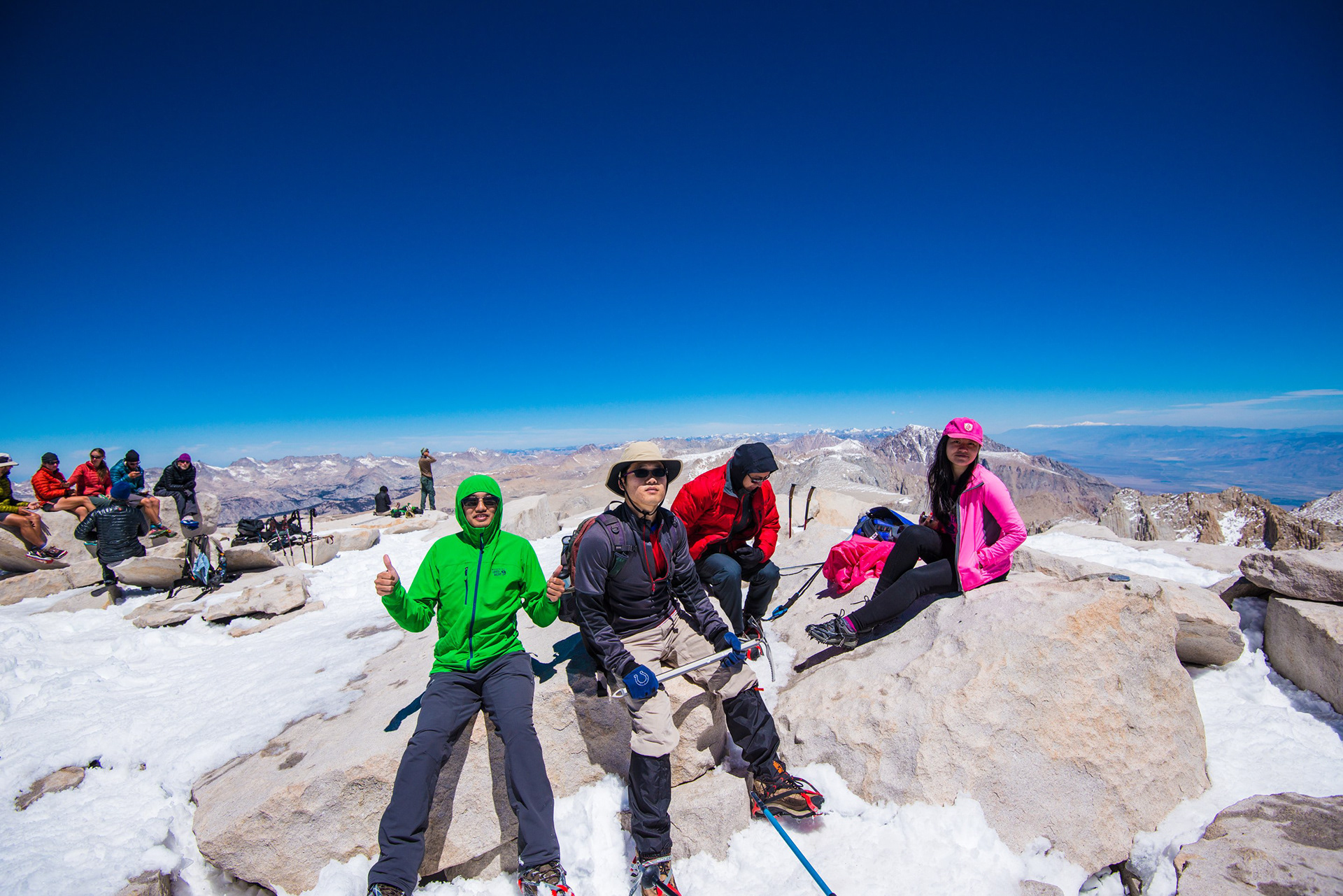
The photo above was taken at the summit of Mt. Whitney — 14,505 feet, the highest point in the contiguous United States, and the view that first made me understand why people do this.
The Naturalist in Progress
There's a quote I keep coming back to: "Nature is not a place to visit. It is home." I didn't always feel that way. For a long time, the outdoors was recreation — something you did on weekends to decompress from the week. Then, somewhere between a tide pool in Half Moon Bay and a ridgeline at 14,000 feet, the relationship changed.
My goal now is to evolve from someone who enjoys nature into someone who genuinely understands it. Not as a scientist necessarily, but as a naturalist in the oldest sense: curious, observant, and fluent enough in the language of ecosystems to know what I'm actually looking at. The West Valley College courses in Park Management and Marine Biology have accelerated that. So has simply spending more time outside, with fewer distractions and better questions.
On Foot
Hiking was the gateway. Over the years I've worked my way up to some of the more serious trails in North America — the summit of Mt. Whitney, Angel's Landing in Zion, the Harding Icefield in Alaska, Grinnell Glacier in Glacier National Park. These days I'm also deep into the Bay Area's local trail network, often with my daughter in tow, which has added an entirely new dimension to the experience. Teaching a small person to notice things — a mushroom, a hawk, a lizard doing pushups on a hot rock — has made me a more attentive hiker than I ever was alone.
Backpacking came later. For years I kept it to day hikes, convinced the logistics of sleeping outside were more trouble than they were worth. A backpacking course through West Valley's Park Management program in 2025 corrected that misunderstanding decisively. Two immersive overnight trips and something fundamental shifted: carrying everything you need on your back produces a specific kind of clarity that I now find difficult to live without. I'm pursuing a Wilderness First Responder certification next, and the Rim-to-Rim Grand Canyon traverse and Half Dome are already on the board.
Through Binoculars
Birding crept up on me the way most good obsessions do — quietly, then all at once. I started noticing birds the way you start noticing cars after you buy a specific make: suddenly they're everywhere, and you can't understand how you missed them before.
The honest obstacle is names. English bird nomenclature is its own ecosystem, and for a non-native speaker it's genuinely humbling — the warblers alone could break you. I've made peace with the fact that I'll be learning these for years. In the meantime, eBird has become my field notebook: a running record of every sighting, every location, every species I can confidently ID. You can follow my observations here.
The gap between seeing a bird and knowing a bird is where I currently live. I find it a good place to be.
Along the Coast
Marine Biology at Mission College opened up an entirely different theater: the intertidal zone. Tide pools are, acre for acre, some of the most biodiverse environments on the planet — and most people walk past them looking for a good Instagram angle. I've been out multiple times now, and each trip recalibrates my sense of scale: you crouch down, look closer, and suddenly a patch of rock the size of a dinner table contains an entire working ecosystem. I go with enough taxonomy to know what I'm looking at, and enough restraint to leave most of it where it is.
On Two Wheels
Cycling occupies a specific niche in my outdoor life: faster than walking, slow enough to actually see things. In 2023 and 2024 I commuted regularly from Sunnyvale to Mountain View along the Bay Trail — rides that were ostensibly practical but functionally meditative, a daily half-hour with the water and the birds and no one's Slack notifications.
The longer ambition is a circumnavigation of Taiwan by bicycle with my daughter. Coast, mountains, night markets, the whole thing. One day.